Oct 7, 2026
Comments
Qt for MCUs 2.12.3 LTS has been released and is available for download. This patch release provides several bug fixes and other improvements while maintaining source compatibility with Qt for MCUs 2.12 (see Qt for MCUs 2.12 LTS released). This patch release is stability and user workflow focused and does not add any new functionality. Below are some highlights of the improvements introduced. A comprehensive list of changes can be found here.
More integrated Qt for MCUs for Zephyr ecosystem
As a welcoming enhancement, Qt for MCUs now can be easily integrated in the west build system of Zephyr build environment. Support for Zephyr west module makes it much easier to integrate Qt for MCUs into Zephyr based projects. Users can use single build systems throughout, as Qt for MCUs can be added as a standard west module and built directly within the Zephyr ecosystem.
For Zephyr users this would help in the following ways
- Simplified integration: Qt for MCUs will be part of the normal Zephyr workspace, reducing setup effort and project complexity.
- Build workflow: customers can use familiar west commands to fetch, configure and build application.
- Easier dependency management: Qt for MCUs sources, platform support and application code are managed alongside other Zephyr modules.
- Faster project onboarding: Users already working with Zephyr can quickly adopt Qt for MCUs without learning a separate build environment.
For detailed documentation on the development flow check the Zephyr Integration documentation.
Platform Updates
Announcing three new platforms which are now tested and verified with Qt for MCUs.
- Nuvoton Gerda 4UL is available via the online installer as a Tier-2 device. That means an out-of-the box QtCreator integration is available to get started on this platform. Several stability fixes has been introduced. We will continue improving both Nuvoton Gerda 4L and 4UL platforms in our future releases.
- Ambiq Apollo 510 also have a latest Qt for MCUs port available now to empower ultra low power devices with fluid graphics.
- A refreshed port for NXP i.MX95 (M7 Core) is now available with 2.12 version. This port is tested with publicly available NXP SDK. This enables both Qt and Qt for MCUs framework co-exist in a hybrid architecture with clear domain separation, without needing a hypervisor to manage complex safety scenarios.
The above demonstration shows how Qt 6.12 and Qt for MCUs 2.12 exists seamlessly on the same SoC separated by physical cores. The safe mcu driven core(Cortex-M7) is where Qt for MCUs renders the safe graphics running on safety certified environments like Autosar classic while the application core(Cortex-A55) handles 3D and other cpu heavy tasks through Qt Quick 3D on Linux or Android. Failure on the application core does not affect the safety core which continues to display critical information on the left side of the screen.
This architecture enables our customers to develop next generation instrument clusters in Micro-mobility and Automotive clusters, end-to-end with Qt.
Figma to Qt for MCUs
The popular Figma plugin from Qt Group is now extended for Qt for MCUs and now officially out and supported from plugin version 1.1 onwards. This is a great milestone for us to enable users to seamlessly transition from an idea in Figma to an actual running application on a resource constrained device. For a detailed overview of this release please visit the official product release blog.
Automated testing enhanced with Squish object awareness
With 2.12.3 we build the base for introduction of Squish for MCUs Object awareness feature in upcoming release in November with Squish 9.3. This will bring the Functional accuracy aspect into the automated testing of MCU application with object based testing capability. Device link support and GDB symbols availability is enough for full support for record, replay, scripted object names, BDD etc. Stay tuned to our blog space for more update.
2.11 and 2.12 lifecycle Update
Following up from our last roadmap update from 2.11 release last year we wanted to notify again that 2.11 LTS will be end of life early 2027 as we continue to work on 2.12 and upcoming 3.x series.
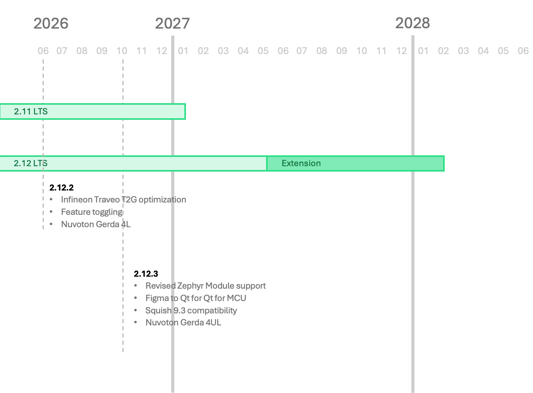
We are currently putting together a robust plan for our next major release, as we do that we have decided to extend the life span of present 2.12 LTS till early 2028. This would provide ample time for 2.x users to prepare for an migration to next major update.
Our next major release will focus on more Cmake oriented developer workflow with improved AI assisted tooling and a complete CRA conformity. Please keep an eye on our space for a detailed update.
As with other Qt products, Qt for MCUs 2.12.3 LTS can be added to an existing installation by using the maintenance tool or via a clean installation using Qt Online Installer.
The extended support period for the Qt for MCUs 2.12 LTS continues until February 2028, while we are working on next patch release. Join us on this year's Qt World Summit 2026 to get more updates on our roadmap and direction as a company.
Blog Topics
Related Articles
From Figma to Qt: A Comparison Between Manual and Assisted Workflows
We know that one of the biggest challenges for embedded UI/UX designers is..
Read Article
Celebrating 30 years of KDE at Akademy 2026
Two weeks ago, several of us from Qt Group travelled to Graz for Akademy..
Read Article