Qt FRAMEWORK
A Single Foundation for Every Target
A stable, extensive software framework for UI and beyond. Support for various backend languages. Open code. Cost-efficient performance from desktop to lower-end hardware. Qt Framework has it all in one.
See What You Can Do with Qt See LicensingThe Software Framework to End Your Integration and Maintenance Struggles

Create appealing software that is both easy to maintain even through very long product lifecycles and that runs smoothly across platforms even with resource constraints. Across targets, build on top of what you already know, re-using the same technology, know-how, and even code. Flexibly combine powerful UI capabilities and time-saving core functionality to glue together your architectural layers without spending time on repetitive tasks. Easily see what's happening and where, thanks to the openness of the code in an out-of-the-box solution that allows customization, topped with detailed documentation, examples, and a large and helpful developer community.
Qt Framework Is Massively Comprehensive
Where Would You Like to Start from?
Qt is more than just a UI tool; it serves as the technological backbone.
Seonggong Moon, Head of Product Development, Oncosoft
What Our Customers Have Achieved with Qt Framework
Key Capabilities of Qt Framework
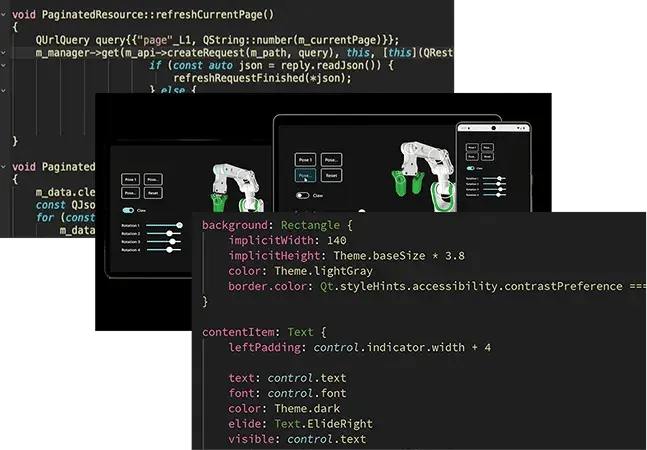
Qt Framework provides developers with a comprehensive set of ready-made, customizable, and very toolable building blocks from UI components to core functionalities. Qt’s libraries and APIs together with the intuitive and declarative QML language provide a clear separation between frontend and backend, enabling your teams to deliver maintainable, clearly structured software.
User Interfaces
Build the kind of UI you need by mixing and matching from the most extensive set of basic and enriched components that are readily suitable for cross-platform use.
3D
Create stunning 3D UI components that run smoothly on real-world hardware and software.
Graphics
Include high-performant 2D and 3D vector graphics into your UI for engaging user experiences.
Graphs
Easily create and customize dynamic 2D & 3D data visualizations from simple to complex needs.
Networking & Connectivity
Remove the complexity of your setups by using a wealth of networking and connectivity protocols and standards as one, consistent entity.
Data Handling
Ease your development efforts with ready-made, cross-platform capabilities to send, receive, save, load, query, manipulate, and serialize data - from UI to I/O.
Accessibility
Easily create cross-platform products for all users, regardless of their ability or environment.
Cybersecurity
Build and maintain secure products easier with ready-made building blocks and robust practices.
Functional Safety
Develop modern embedded systems that are both functionally safe and fully dependable.
1+ Billion Devices and Applications Are Powered by Qt Framework
Qt Framework naturally enables creating components that can be reused across projects and appliances.
Daniel Dersmann, Head of Global GUI Framework Development, BSH
A Single Frontend for Different Backends
Support for a Growing Number of Programming Languages
In the past, Qt Framework was C++ by tradition. Nowadays, the support for different programming languages has evolved, and keeps evolving, to more and more backend languages.
Qt Framework’s modern frontend capabilities are available with QML, an easy-to-learn UI language. It enables a clean separation of your backend and frontend, giving you the flexibility to choose the best suited one for each application layer and each project depending on your choice of backend language.
Now in Technology Preview
Try Qt Bridges for C# and Rust
Qt Bridges is a UI bridging technology that lets you use modern Qt as the frontend for many backend languages. You write your UI once in QML and keep your application logic in your backend language and workflow.

EFFICIENCY ACROSS PRODUCT LINES
Scale with the Cross-Platform Qt Framework
With Qt Framework, your products run smoothly regardless of the operating system.
Reusable Code
Code once and deploy across embedded, mobile, and desktop platforms with minimized rework:
- A single codebase that adapts across platforms,
- Support for multiple product lines.
Shorter Time-to-Market
Skip the need for multiple platform-specific skills. Reduce development and maintenance efforts. Prototype rapidly. And as a result, get your product to the market fast.
Deploy Across Platforms
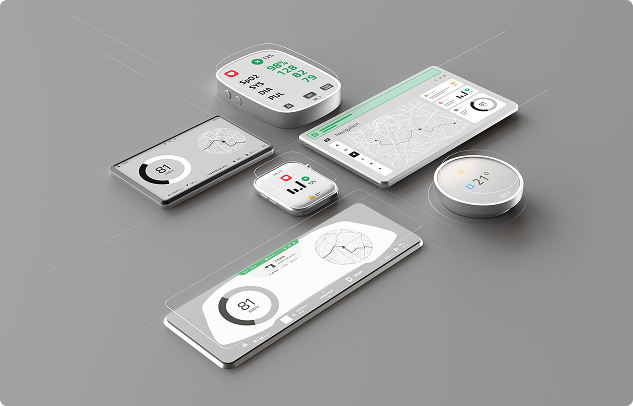
No more heavy and slow cross-platform frameworks; Develop rapidly with ready-made components and efficiently deliver with real-time, fast responsiveness and consistent user experience across various devices, platforms, and product lines, reducing complexity and shortening your time-to-market.
Embedded Devices
Run Qt across a variety of devices from smart home appliances to cars to medical devices and to industrial GUI software, meeting the highest quality standards.
Run Qt on Embedded DevicesDesktop & Web
Run Qt across a variety of platforms and operating systems, including Windows, Windows on Arm, macOS, Linux, and web with native performance.
Run Qt on DesktopMCUs
Reuse your UI in the realm of embedded microcontrollers, enabling smartphone-like user experiences on resource-constrained devices.
Go to Qt for MCUsMobile Platforms
Run Qt-powered companion mobile apps across Android and iOS platforms, or add flare like 3D graphics even to your native mobile application.
Run Qt on Android & iOS
SAFE CHOICE
Keep Your Software Reliable Over Time
Build your product with greater certainty on a proven, stable, and supported foundation, making it a safe choice also for long-term projects.
Upgradability
Easily stay compatible with latest operating systems and hardware without costly rewrites. Evolve your product to meet changing usability and use case needs.
Longevity
Qt has been around for decades and continues to evolve with robust and continuous maintenance. Its sustainability is further backed up by the vast open source community.

Develop Consistently with Qt Framework
Release Cycle
Qt Framework’s Major, Minor, and Maintenance releases provide new features and maintenance for all needs.
Long-Term Support
When your product need to run smoothly for years, LTS provides a solid foundation for development stability.
Licensing
Qt’s Dual Licensing Model comes with options for both scalable businesses and community projects.
Latest Blogs on Qt Framework
New release cadence for Qt WebEngine and Qt PDF
Starting with Qt 6.12, Qt WebEngine and Qt PDF are released as Qt Exte...
Qt Bridges Technology Preview: Qt Quick UIs for Rust and C# Developers
When we announced Qt Bridges at Qt World Summit 2025, we had a simple ...

With Qt 6.12, the SkyMaterial is the limit
Qt Quick 3D 6.12 introduces a new SkyMaterial QML type, and in this po...
Development Tools
Qt provides a wealth of tooling to choose from, including its own integrated development environment (IDE) and support for other IDEs.
Community
The Qt Project governs the open source development of Qt, welcoming anybody wanting to contribute to join the effort.
Get Started with Qt Framework
Build complete cross-platform products with Qt Framework’s comprehensive set of libraries and APIs for UIs and core functionality.